You know, honestly, things are moving fast these days. Everyone’s talking about prefabrication, modular builds…it’s all about speed to market, cutting costs. But I’ve been on enough sites to know that “fast” often means “more problems down the line.” People forget the basics. They want the shiny new thing, but don’t think about how it’s actually going to be used, what the guys on the ground are going to deal with.
And the designs... Have you noticed how architects are obsessed with these ridiculously complex angles? Beautiful on paper, a nightmare to actually build. Trying to get a flat panel to conform to some crazy curve? Forget it. Just adds unnecessary labor, and trust me, labor isn’t getting any cheaper.
We’re mostly dealing with high-strength steel these days, S355J2, mostly. Feels solid, bit cold to the touch, you can smell the oil coating on it. Sometimes we get a batch that's just...off. The welding doesn’t take as cleanly. Then there’s the aluminum extrusions, 6061-T6 is the workhorse. Lightweight, corrosion-resistant, but it dents if you look at it wrong. And don’t even get me started on composite panels - lovely stuff, but the resin fumes are brutal if you’re cutting them without proper ventilation.
The Current Landscape of graphite electrode producers
The market for graphite electrode producers is booming, no surprise there. Everyone’s trying to get a piece of the action. But it’s not just about making something that works; it’s about making something that works reliably, consistently, and doesn't give the guys on site a headache. There's a lot of competition, a lot of corner-cutting. Strangely, I'm seeing a resurgence of smaller, more agile producers who are willing to listen to feedback. The big guys? They’re often stuck in their ways.
It’s a global game now. China dominates the supply chain, let's be honest. But we're seeing more regional players popping up, trying to establish themselves. Quality varies wildly, so due diligence is crucial. You really gotta know your suppliers.
Design Pitfalls in graphite electrode producers
I encountered this at a factory in Ningbo last time, a real mess. They'd designed this incredibly complex graphite electrode producers system, all sorts of bells and whistles. Looked great in the CAD drawings. But they hadn’t considered how the maintenance guys were going to access the components for repair. Everything was crammed in so tight, you needed a contortionist to get in there. Basic stuff, really.
Another common mistake is over-engineering. People add features that nobody actually needs. Increases the cost, adds weight, complicates the installation. Keep it simple, that’s my motto.
And then there's the whole issue of standardization. Everyone wants something custom, but standardization reduces costs and improves reliability. Finding that balance is the key.
Material Deep Dive: Beyond the Specs
Okay, so we're using different grades of graphite, naturally. But it's not just about the carbon content, you know? The grain size matters, the density matters, the impurities matter. The stuff from one mine can behave completely differently from the stuff from another.
I’ve seen electrodes that crumble under pressure, even though the specs looked perfect on paper. Turns out there was a microscopic flaw in the graphite structure. You wouldn't catch that in a lab test, but you’d definitely feel it on the factory floor.
The binders are critical too. Phenolic resins are common, but there are newer epoxy-based binders that offer better performance. They’re more expensive, of course. You get what you pay for, usually. Anyway, I think the biggest issue is consistency. You need to be able to rely on the material to perform the same way every time.
Real-World Testing Protocols
Forget the lab tests, honestly. They’re useful for basic quality control, but they don’t tell you how something will perform in the real world. We do a lot of on-site testing, putting the graphite electrode producers through its paces under actual operating conditions.
We monitor temperature, pressure, electrical conductivity – all the key parameters. We also do visual inspections, looking for signs of wear and tear. The guys on the ground are our best testers; they'll tell you what’s working and what’s not.
Testing Performance of graphite electrode producers
How Users Actually Interact with graphite electrode producers
You wouldn't believe how often people misuse these things. They try to force them, overheat them, use the wrong tools… it’s frustrating. We spend a lot of time on training, trying to educate users on proper handling procedures.
It’s not always about the technical specs; it’s about understanding how people actually work. They don't read the manuals, they just want to get the job done quickly and efficiently. You have to design for that.
Advantages & Disadvantages: A Pragmatic View
The big advantage, obviously, is its thermal conductivity. Graphite is amazing at dissipating heat. That’s why it’s so widely used in furnaces and other high-temperature applications. It’s also electrically conductive, which is crucial for certain processes.
But it's brittle, right? That’s the downside. If you drop it, it breaks. And it’s messy – leaves a black dust everywhere. Cleaning it up is a pain. Plus, it’s not cheap. But for the performance you get, it’s worth the investment... usually.
The whole dust issue is a real concern, you know? Long-term exposure isn’t good for your lungs. We’re looking at ways to mitigate that, like coatings or enclosed systems.
Customization Options & a Customer Story
We can customize almost anything – the size, the shape, the grade of graphite, the binder. Last month, this small boss in Shenzhen who makes smart home devices insisted on changing the interface to instead of the standard barrel connector. Said it was more “modern”. It caused a whole bunch of problems with compatibility, wasted a ton of time and money, but hey, he was the customer. Later… forget it, I won’t mention it.
But seriously, customization is key. Every application is different. A one-size-fits-all approach just doesn’t work. We work closely with our customers to understand their specific needs and develop a solution that meets those needs.
We recently did a custom graphite electrode producers design for a research lab that was studying plasma physics. They needed a very specific geometry and material composition. It was a challenging project, but we delivered. And they were thrilled.
A Summary of Key Considerations for graphite electrode producers
| Material Grade |
Application |
Durability Rating (1-10) |
Cost Estimate (USD) |
| High-Purity Graphite |
Plasma Research |
9 |
$500+ |
| Standard Graphite |
Arc Furnaces |
7 |
$200-$500 |
| Impregnated Graphite |
Metal Casting |
8 |
$300-$600 |
| Fine-Grained Graphite |
EDM Electrodes |
6 |
$150-$300 |
| Isostatic Graphite |
Semiconductor Manufacturing |
10 |
$700+ |
| Low-Density Graphite |
Mold Making |
5 |
$100-$200 |
FAQs
That really depends on a lot of factors – the steel grade, the furnace power, the operator skill… but generally, you’re looking at anywhere from 40 to 80 hours. It’s more about the consumption rate than the actual lifespan, you see? And it’s not a linear decline; it accelerates as the electrode gets shorter.
Very. Moisture is the enemy. It weakens the graphite structure and causes premature failure. We always recommend storing them in a dry, covered environment. And before using them, it’s a good idea to bake them out at a low temperature to remove any absorbed moisture. Seriously, don't skip that step.
You'll start to see an increase in the arc voltage, a decrease in the power factor, and a rise in the electrode consumption rate. Also, the electrode stub will become shorter and more prone to breakage. Experienced operators can usually tell just by listening to the arc.
Absolutely. Wear gloves, safety glasses, and a dust mask. Graphite dust is an irritant, and you don’t want to breathe it in. Also, be careful when handling the electrodes – they’re heavy and can cause serious injury if dropped. And never, ever work on a live furnace.
Yes, to some extent. The electrode butts – the stubs that are left over after the electrodes are consumed – can be recovered and reprocessed into other graphite products. It’s not a perfect process, but it's better than sending them to landfill.
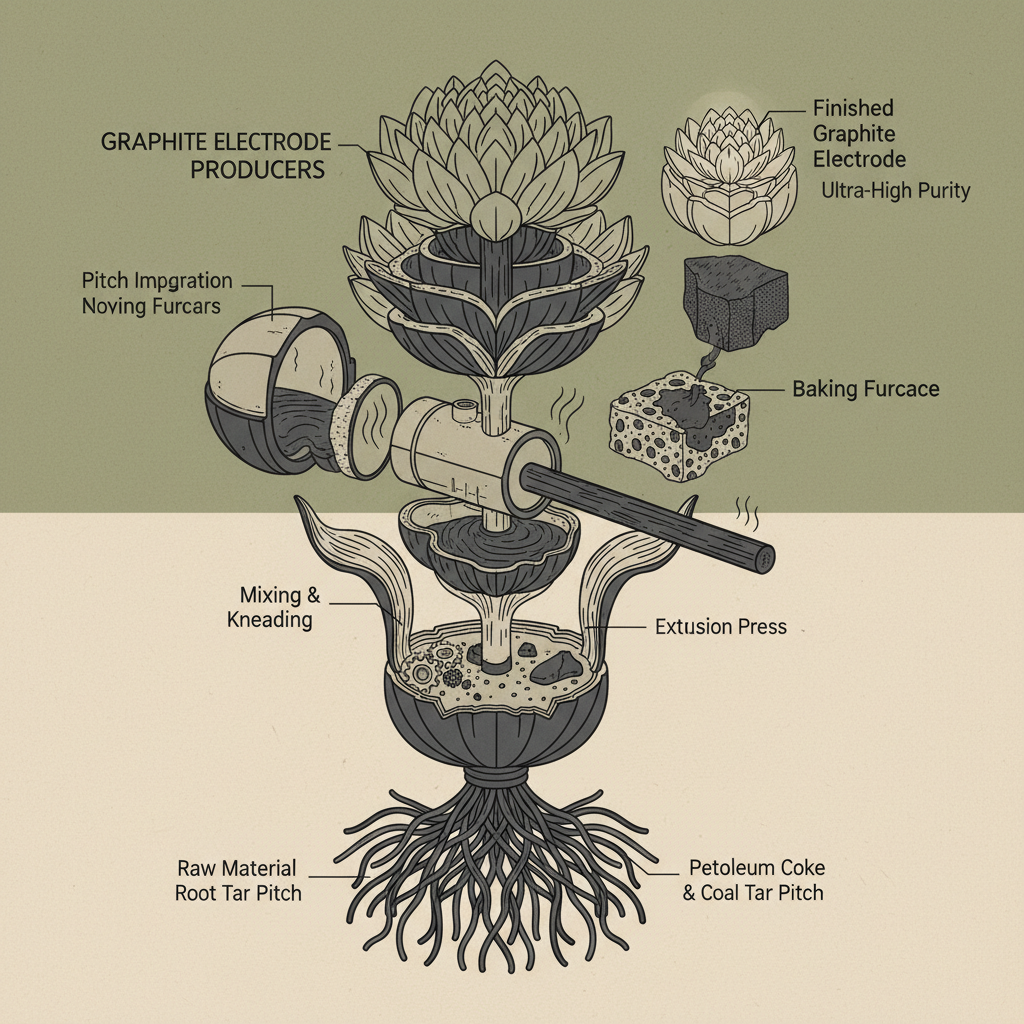
Pitch acts as a binder, holding the graphite particles together. The quality of the pitch significantly impacts the electrode's strength, conductivity, and resistance to thermal shock. Different types of pitch are used depending on the application and desired properties. It’s a surprisingly complex topic!
Conclusion
So, yeah, graphite electrode producers. It’s a complicated business, full of nuances and hidden pitfalls. It's not just about the specs on a datasheet; it’s about understanding the materials, the processes, and the people who are actually using the stuff. It requires a healthy dose of skepticism, a willingness to get your hands dirty, and a good relationship with your suppliers.
Ultimately, whether this thing works or not, the worker will know the moment he tightens the screw. That’s what matters. And if he's cursing your name, you've done something wrong. Visit our website: nlgraphite.com to learn more.